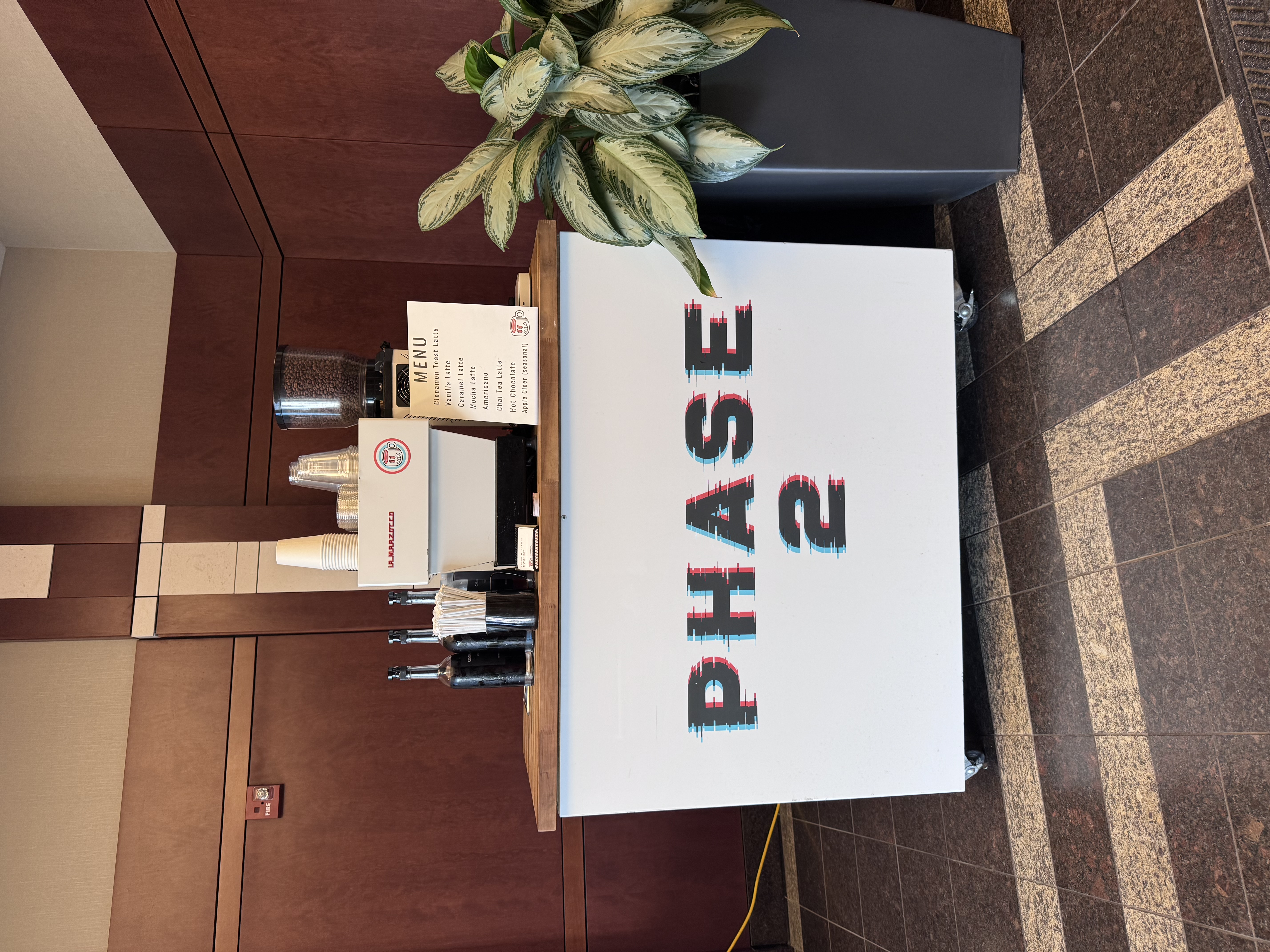
Every business starts with a moment where someone looks at how something is being done and thinks: this could be so much better. For Phase 2 Coffee Co., that moment happened at an event in Kansas City.
The food was good. The bar was stocked. The venue looked great. But the coffee — the thing a significant number of people actually wanted — was an afterthought. A hotel-lobby urn in the corner. Paper cups and powdered creamer. No craft, no presentation, no experience. Nothing that matched the energy of everything else happening in that room.
What struck me wasn't just the bad coffee. It was the contrast. I'd been to events where the bar program was genuinely elevated — where someone had thought carefully about the experience of ordering a drink, waiting for it, holding it, tasting it. That same intentionality had never been applied to coffee at events in Kansas City. Not at the level I was imagining. Not as a real experience that competed with everything else happening at the event.
That gap was Phase 2.
THE BEGINNING — ALL IN
Building a business from nothing means making decisions that are uncomfortable to think about too long. I took my savings — everything I'd set aside — and put it into a coffee cart. Not a franchise. Not a proven model with a roadmap and a support system. A cart, equipment, and the belief that what I was imagining could actually work.
The early days were not glamorous. We did small pop-ups. Graduations. Backyard weddings. Events where I was the barista, the salesperson, the setup crew, and the breakdown crew — sometimes all in the same afternoon. The cart went places I'd never imagined it would go, and not always in a good way. There were events where I wasn't sure it was going to work out, and not just logistically.
The harder challenge wasn't operational. It was conceptual. Kansas City didn't have a category for what we were doing yet. People understood catering. They understood a coffee shop. They didn't quite understand a premium mobile espresso experience that could show up at their event, look like a flagship café, and produce drinks that were genuinely better than most brick-and-mortar spots in the city. We were selling something the market hadn't bought before.
"Kansas City didn't have a category for what we were doing yet. We weren't just building a business — we were building the market for it."
That's a specific kind of hard. It's not the hard of competing against established players. It's the hard of explaining your value proposition to someone who doesn't yet have a frame of reference for it. Every sales conversation started a step further back than it would have if we'd been the third mobile coffee cart in the city. We were the first one doing it at this level, which meant we were educating while selling — always a slower path.
But I believed in it. Not recklessly — I understood what we were building and what it would take. I believed in it because I'd seen what happened when someone experienced what we were capable of. The moment someone got a well-made drink from a beautifully set up cart, in a context where they'd expected nothing, and their face changed — that was the proof of concept that kept everything moving forward.
FROM POP-UPS TO BOARDROOMS
The progression wasn't linear, and it wasn't fast. But it was real. Weddings turned into referrals to corporate contacts. A strong event at a graduation got us in front of an HR director who needed something for a company-wide function. One well-executed corporate event led to a conversation that led to a brand activation that led to a concert.
Each phase of the business felt like climbing to a new vantage point — you could see further, the conversations got different, the stakes got higher, and the standard you had to hold yourself to got higher with them. Going from small pop-ups to weddings meant learning how to manage the emotional weight of someone's most important day. Going from weddings to corporate events meant learning how to operate with a level of professionalism and reliability that Fortune 500 companies require. Going from corporate events to brand activations and concert tours meant learning how to execute at scale, under pressure, in environments that didn't care about your learning curve.
Every level taught us something the previous level couldn't have.
Pop-Ups & Private Events
The foundation. Small gatherings, graduations, backyard weddings. Learning the craft, the logistics, and what it means to deliver an experience people don't expect.
Weddings & Social Events
A turning point. Weddings demanded a higher standard — the setup, the service, the consistency. The referral network started building here.
Corporate Events & Brand Activations
The market started to understand what we were offering. Fortune 500 companies, executive events, employee appreciation — and the first branded cart wraps for major companies.
Concert Tours & Major Activations
Katy Perry. Tim McGraw. Billie Eilish. Riley Green. The level that most mobile coffee operations never reach — serving world tours at T-Mobile Center.
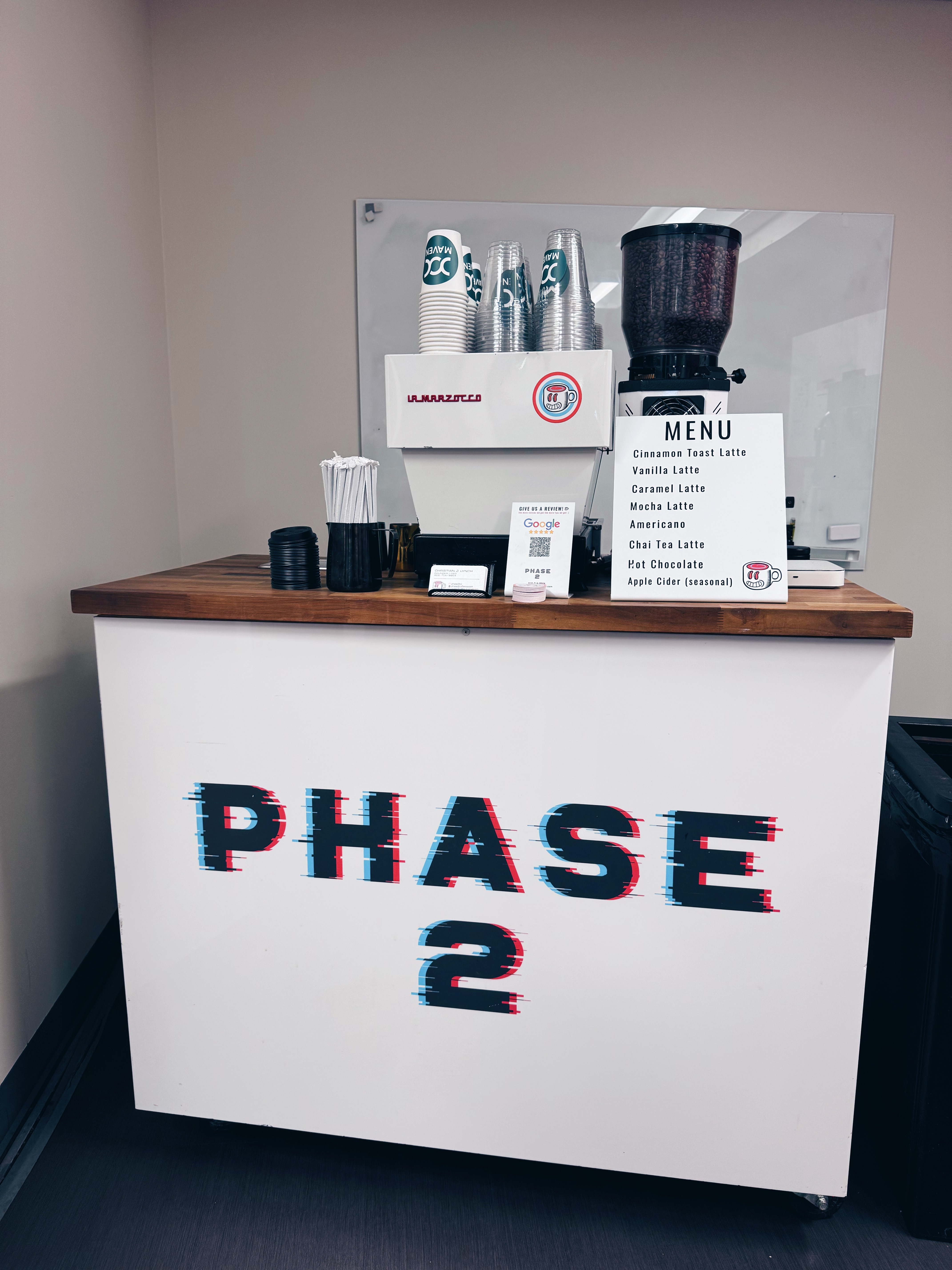
Phase 2 Coffee Co. — bringing the full production experience to Kansas City events
THE NIGHT WE SERVED A WORLD TOUR
There's a version of this story where I describe the first major concert activation in a way that makes it sound inevitable — like the natural outcome of everything that came before it. That's not entirely honest.
Getting to the level of serving Katy Perry, Tim McGraw, Billie Eilish, and Riley Green at T-Mobile Center in Kansas City required something that no amount of preparation fully covers: the willingness to say yes to something before you're completely certain you're ready, and then figure it out. Those opportunities don't come with a comfortable lead time and a soft landing. They come fast, they ask for a lot, and they don't care about your previous experience level.
What they do care about — what every client at that level cares about — is execution. Can you show up, set up, produce drinks at volume, maintain quality under pressure, and make the experience feel premium when the room is full and everything is moving? That's the only question that matters at that level, and the answer either earns you the next one or it doesn't.
We earned the next one. And the one after that.
Those concert activations changed something about how Kansas City's event industry understood Phase 2. When you've served coffee to world-touring artists and their production teams in the same market where you started doing backyard pop-ups, the story of the brand becomes something different. The credibility isn't claimed — it's demonstrated.
"Credibility isn't claimed. It's demonstrated. Every event we've done — from the first small pop-up to a Katy Perry tour stop — built the same thing: proof that we do what we say we do."
WHAT "PHASE 2" ACTUALLY MEANS
The name isn't random. Phase 2 is about the next level — the idea that whatever you're doing right now, there's a version of it that's better, more intentional, more elevated. That applies to coffee at events. It applies to the events themselves. And honestly, it applies to the way we think about building this business.
We're not here to just pour coffee. We're here to take whatever event you're planning to its next phase — to be the thing that changes the energy in the room the moment people walk in. The thing that creates conversation before anyone has to force it. The thing that says to every person who walks up to the cart: someone thought about you specifically when they planned this.
That philosophy — coffee as experience, not just caffeine delivery — is what drove every decision from the first pop-up to the current operation with three carts, a full team, and a director running day-to-day operations. It's the same idea it's always been. We've just gotten considerably better at executing it.
WHY KANSAS CITY SPECIFICALLY
This matters more than it might seem. Kansas City is not New York or Los Angeles or Chicago — cities where the market for premium mobile experiences was already formed before anyone got there. Kansas City is a market you have to build. The relationships are real but they take time. The corporate community is tight-knit and discerning. The event industry here rewards quality and consistency because word travels fast when you're good, and equally fast when you're not.
Building Phase 2 in Kansas City meant building something that could earn its place in that ecosystem through performance, not marketing. Every corporate client we've served in the KC metro — from Busey Bank executives flying in from out of state to the Polsinelli Business Law Institute to JE Dunn to StackAdapt and beyond — came through a referral network built one well-executed event at a time.
That's a slower path than a market with existing demand. It's also a more durable one. The companies that hire us aren't doing it because we showed up in an ad. They're doing it because someone they trust told them we were the best option in the city for what they needed. That's the kind of reputation you can't manufacture — you can only earn it.
Kansas City is our market. We know it, we've invested in it, and we're proud to be the operation that changed what people here expect from a coffee experience at an event.
WHERE WE ARE TODAY
Three carts. A full-time operations director. A trained barista team. A client roster that spans Fortune 500 companies, world concert tours, Kansas City's most memorable weddings, and some of the biggest brand activations in the region.
We serve corporate events, employee appreciation functions, executive gatherings, brand activations, concerts, weddings, graduations, and everything in between — across the entire Kansas City metro including Overland Park, Leawood, Lee's Summit, Olathe, Shawnee, and beyond.
The operation looks different than it did when it was one person and one cart. The commitment underneath it is identical: show up, do it right, make the experience matter.
If you're planning an event in Kansas City and you want the coffee to be part of the experience rather than an afterthought — that's exactly what we're here for.