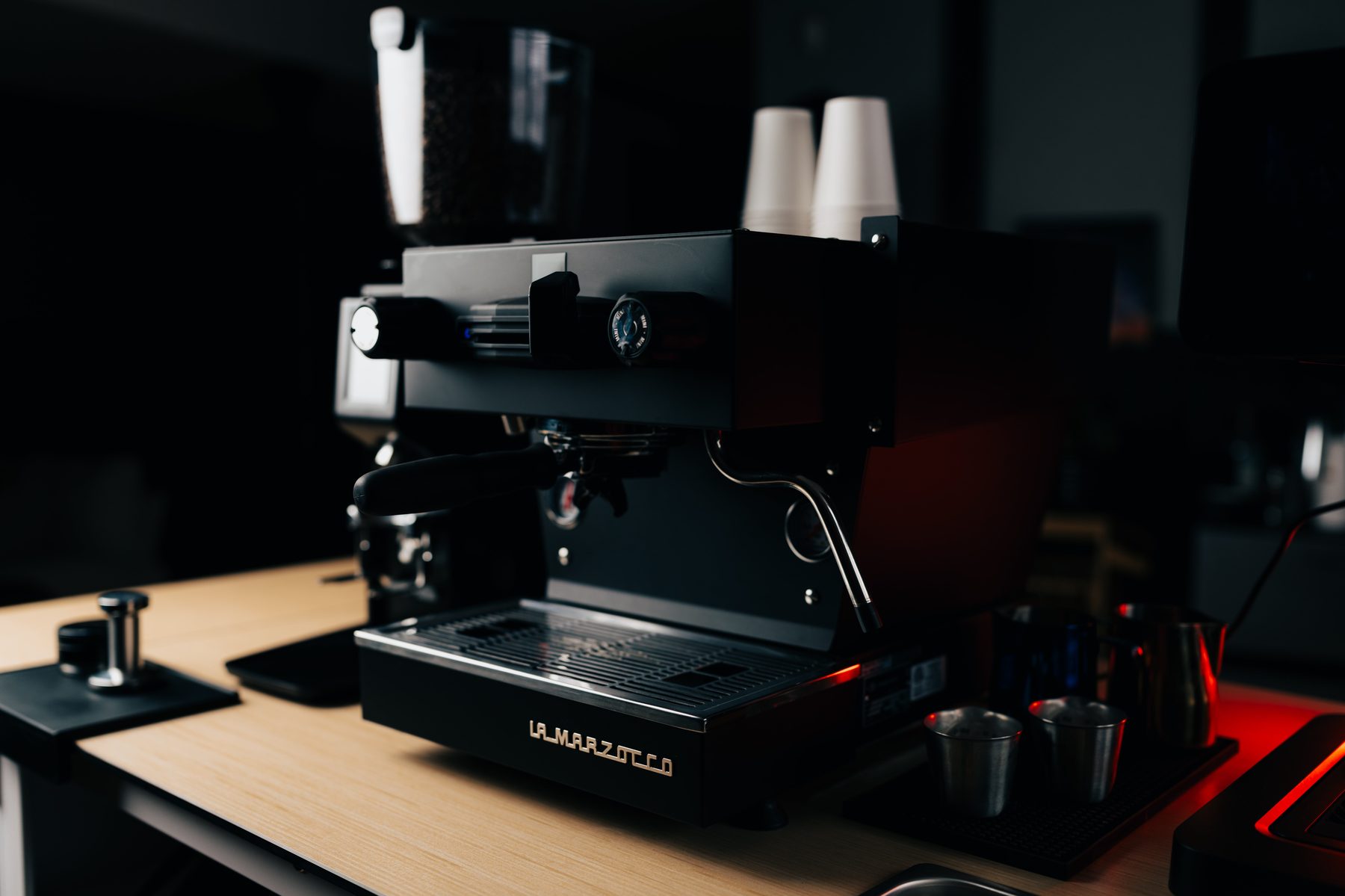
Most people can't name the espresso machine at a coffee shop. They just know whether the drink is good or not. But the machine is almost always why — and in the world of specialty coffee, one name comes up more than any other when the standard being chased is genuine excellence: La Marzocco.
Founded in Florence, Italy in 1927, La Marzocco has spent nearly a century building machines that define what professional espresso looks like at its highest level. The cafés that get written about. The competition baristas who win world championships. The Michelin-starred restaurants that take their coffee program as seriously as their food. The world-touring artists who specify exactly what equipment they want backstage. They're all using La Marzocco.
At Phase 2, it's the machine behind every event we do in Kansas City — from 50-person corporate gatherings to 5,000-person brand activations at T-Mobile Center. That's not an accident and it's not a branding decision. It's the result of understanding exactly what separates a genuinely premium coffee experience from one that just looks like it.
THE ENGINEERING BEHIND THE STANDARD
To understand why the La Marzocco matters, you need to understand what actually makes a great espresso shot. Espresso is pulled under approximately 9 bars of pressure at a water temperature between 90°C and 96°C, for somewhere between 25 and 35 seconds. Change any one of those variables by even a small amount and the shot changes — the extraction shifts, the sweetness drops, the bitterness climbs, the crema collapses.
Consistency at that level of precision is an engineering problem. And it's one La Marzocco has spent nearly a century solving better than anyone else.
Dual boiler system
Most commercial espresso machines use a single boiler that has to balance two competing temperature demands: brewing espresso requires one temperature, steaming milk requires another. Single-boiler machines compromise on both. La Marzocco pioneered the dual boiler design — a separate boiler for brewing and a separate boiler for steaming, each maintained at its ideal temperature independently. The result is that a barista can pull a shot and steam milk simultaneously without either process compromising the other. At a high-volume event, where drinks are being made back to back for a hundred people in an hour, this matters in every single cup.
PID temperature control
A PID (Proportional-Integral-Derivative) controller is the system that regulates brewing temperature with precision measured in fractions of a degree. La Marzocco integrates PID control at both the boiler and the group head level — the part of the machine where water actually meets coffee. This means the temperature the barista sets is the temperature the water arrives at the puck, every time. Specialty coffee research has consistently shown that brew temperature stability is one of the most significant variables in extraction quality and shot consistency. It's the kind of engineering detail most people will never think about, but taste in every sip.
Saturated group head
La Marzocco's saturated group head design keeps the brewing chamber thermally stable by circulating hot water continuously through the group — eliminating the temperature drop that happens in conventional machines between shots. In a busy event environment where shots are pulled in rapid succession, this means the fifth drink tastes as good as the first. That's not a minor footnote. At an event with 200 guests, it's the difference between a genuinely consistent experience and one that degrades as the line grows.
"The fifth drink at a busy event should taste as good as the first. That's not luck — it's what the right equipment makes possible."
WHAT PREMIUM EQUIPMENT ACTUALLY PRODUCES
The engineering specifications matter because they translate directly into what ends up in the cup. Here's what a La Marzocco-pulled shot produces that a lesser machine simply can't replicate consistently.
Crema that holds
The golden-brown crema on top of a well-pulled espresso shot isn't decorative — it's a physical indicator of extraction quality. It's an emulsion of oils, carbon dioxide, and water created by the pressure of the extraction. A machine with inconsistent pressure or temperature produces crema that's thin, pale, and dissipates within seconds. A La Marzocco produces crema that's rich, dense, and persistent — the kind that sits on top of a latte art pour and holds its structure. Guests notice this even if they can't articulate why their drink looks different from what they're used to.
Balanced extraction — sweetness without bitterness
The bitter coffee experience most people associate with bad espresso is almost always a result of over-extraction — water moving through the coffee grounds at the wrong temperature or pressure, pulling the harsh compounds out alongside the desirable ones. La Marzocco's temperature stability and pressure consistency produce what specialty coffee professionals call a balanced extraction: the full sweetness and complexity of the coffee comes through cleanly, without the bitterness that drowns it out. It's the difference between a drink guests finish and one they set down after two sips.
Milk texture that builds latte art
The steam wand on a La Marzocco produces what baristas call microfoam — milk that's been texturized at a microscopic level, creating a velvety consistency that integrates with espresso rather than sitting on top of it. This is what makes latte art possible, but more importantly it's what makes the drink taste the way it's supposed to. Properly textured milk is sweet, creamy, and smooth. Over-steamed milk from an underpowered machine is thin, bubbly, and scalded. Every iced latte, hot latte, and cappuccino we serve at Phase 2 events is built on milk that's been steamed correctly — and that starts with having the boiler capacity to do it right.
Separate brew and steam boilers maintain ideal temperatures simultaneously — no compromise between espresso and milk quality.
Temperature stability within fractions of a degree at the group head — the most critical variable in shot consistency.
The industry standard for optimal espresso extraction — consistent across every shot, every service.
Continuous hot water circulation eliminates temperature drop between shots — the first and the fiftieth taste the same.
WHAT THE MACHINE SIGNALS TO YOUR GUESTS
Here's the thing about premium equipment at events: most guests won't know they're looking at a La Marzocco. They won't recognize the name or read the badge on the front. But they will perceive something about the setup — an aesthetic weight, a sense of seriousness, a visual quality that registers as premium even without a label.
The La Marzocco is an exceptionally designed object. Its lines are clean and architectural. The chrome and stainless steel finish reads as professional in a way that consumer-grade equipment simply doesn't. When it's set up on a Phase 2 cart at an event, it signals to everyone who walks up that this isn't a basic coffee service — that someone made deliberate choices about quality, not just coverage.
This matters in a specific way at corporate events and brand activations. Companies spend significant resources on their brand — on what their spaces look like, what their materials feel like, what the overall experience of engaging with them communicates. A coffee setup that looks and performs at a premium level is consistent with that investment. One that doesn't creates a subtle but real mismatch that guests feel even when they can't name it.
"Guests don't need to know what a La Marzocco is to feel the difference. Premium equipment communicates quality before the first sip."
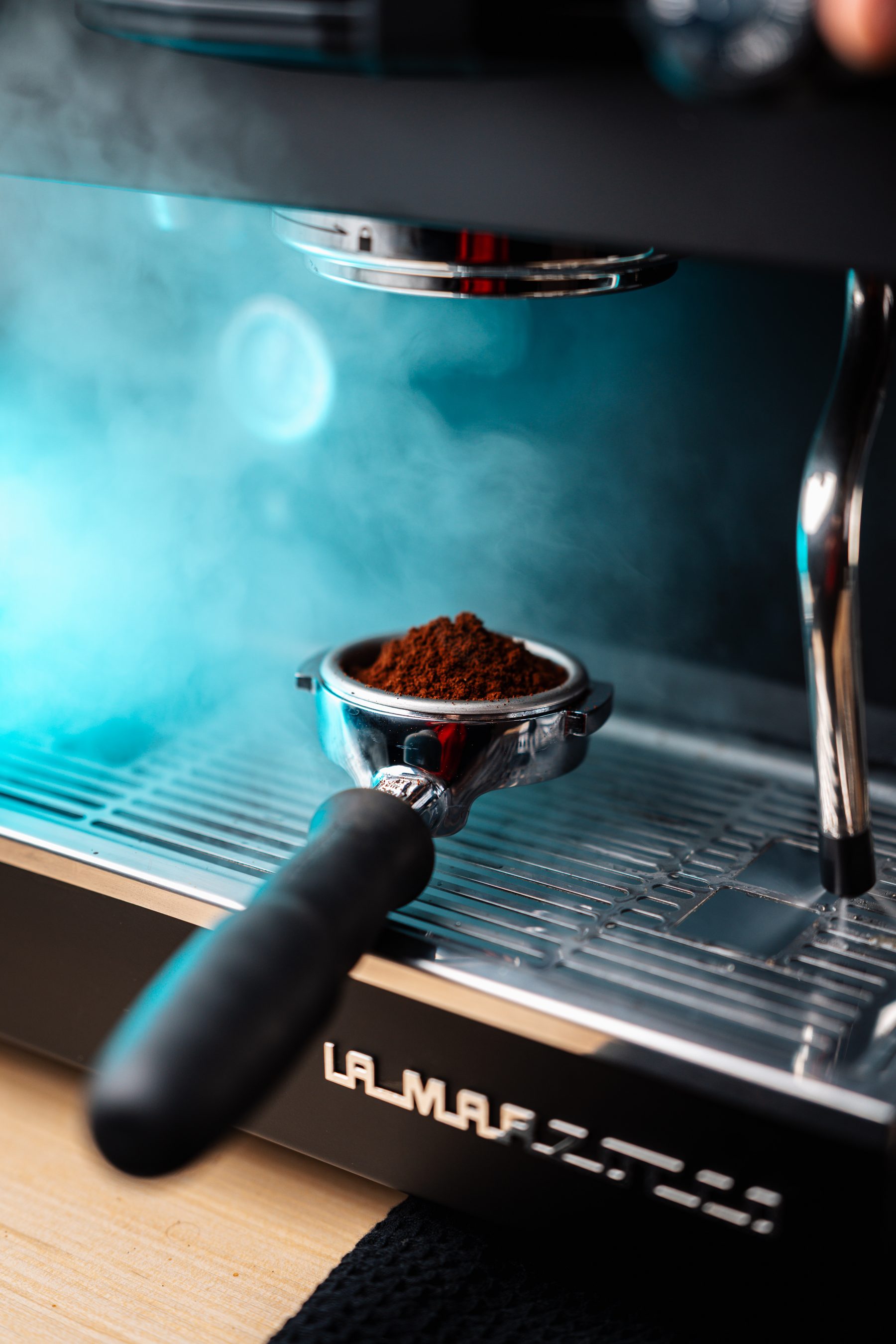
Every drink at every Phase 2 event — built on the La Marzocco standard
THE SMALL DETAILS THAT ADD UP
The La Marzocco is the centerpiece, but premium espresso at events is a system — and every detail in that system either upholds the standard or undermines it. At Phase 2, we've thought carefully about every variable in the chain.
The grind
An exceptional espresso machine paired with a mediocre grinder produces mediocre espresso. Espresso grind consistency — the uniformity of particle size as coffee is ground — is a primary determinant of extraction quality. We use professional-grade grinders that produce a consistent, uniform grind particle distribution at the dose that our baristas have dialed in for the specific coffee and the specific conditions of each event. A grinder that produces uneven particles extracts unevenly — part of the puck over-extracts, part under-extracts, and the result is a flat, muddy shot.
The coffee
Equipment can only do so much. The coffee going into the machine matters. We source specialty-grade espresso roasted for the extraction profile of the La Marzocco — coffee with the density, moisture content, and flavor development that rewards the precision the machine is capable of. Using commodity-grade coffee in a La Marzocco is like putting regular gas in a performance engine. It runs, but it misses the point.
The water
Water chemistry affects espresso extraction in measurable ways. The mineral content of water — specifically its hardness and alkalinity — influences how efficiently it extracts the compounds in coffee. Too soft and the extraction is flat; too hard and it's harsh. We filter our event water to a profile that supports optimal extraction, which also protects the machine from the scale buildup that destroys boilers over time.
The barista
The La Marzocco gives a skilled barista an exceptional platform to work from. It doesn't make every barista exceptional. Our team trains extensively on the machine — understanding how to read a shot, how to adjust grind and dose in response to what the extraction is telling them, how to texture milk correctly, how to manage high-volume service without sacrificing consistency. The machine raises the ceiling. The barista determines how close to that ceiling every drink lands.
WHY IT MATTERS AT YOUR EVENT SPECIFICALLY
If you're planning a corporate event, a brand activation, a wedding, or any gathering in Kansas City where you want the coffee experience to be genuinely memorable rather than just adequate — the equipment your mobile coffee service uses is not a minor detail.
It's the thing that determines whether drinks are consistent from the first guest to the last. Whether the iced latte someone photographs and posts looks as good as it tastes. Whether the barista behind the cart is working with a tool that supports their craft or fighting against one that limits it. Whether the setup signals premium or settles for functional.
We've served coffee at world concert tours — Katy Perry, Tim McGraw, Billie Eilish, Riley Green — where the production teams specified equipment standards that matched the rest of their operation. We've served Fortune 500 companies whose executives flew in from out of state and whose event planners cared deeply about every touchpoint. We've served weddings where the couple wanted a coffee experience that matched the quality of everything else they'd invested in for that day.
In every one of those contexts, the La Marzocco was part of why the experience delivered. Not the whole story — but the foundation that everything else was built on.
That's why we don't compromise on it. And that's why it shows up at every event we do, regardless of size or setting.